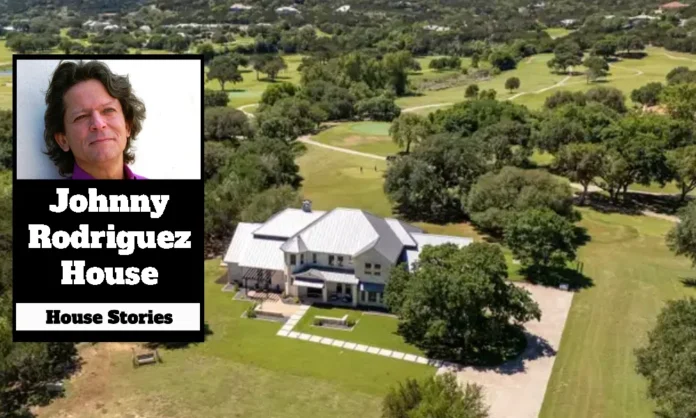
Johnny Rodriguez house is a $560,000 limestone home on the Far West Side of San Antonio, Texas. The four-bedroom property features vaulted wood-beam ceilings, a dedicated music and memorabilia room, and a setting near the Hill Country landscape where Rodriguez spent his youth. He lived there with his wife Debbie and daughter Aubry until his death on May 9, 2025.
He arrived in Nashville with a guitar and $14 in his pocket. He left with six number-one hits, 45 charted singles, and a place in country music history as the first major Hispanic star the genre had ever seen. But the house Johnny Rodriguez built for himself at the end of his life tells a different story than you might expect — no infinity pool, no home theater, no six-car garage. What it has is something rarer: a $560,000 limestone home on the outskirts of San Antonio, close to the Texas soil that shaped him, designed entirely around music, family, and quiet.
Rodriguez passed away on May 9, 2025, at age 73 in San Antonio. The home he shared with his wife Debbie and daughter Aubry stands today as a reflection of who he was — grounded, private, and deeply rooted in South Texas. This article takes you through every room, every story, and every reason this modest estate matters more than any mansion on the celebrity circuit.
Who Was Johnny Rodriguez?
Juan Raoul Davis Rodriguez was born on December 10, 1951, in Sabinal, Texas — a small town about 90 miles from the Mexican border. He was the second youngest of ten children, raised in a four-room house, and lost his father to cancer at 16. His brother died in a car accident the following year. He started singing for campers at Garner State Park at 15 just to eat.
At 21, he moved to Nashville with a guitar and $14. Tom T. Hall hired him as lead guitarist and helped him land a deal with Mercury Records. His debut single, “Pass Me By (If You’re Only Passing Through),” reached No. 9 on the Billboard country charts in 1972. The Academy of Country Music voted him Most Promising Vocalist that same year. By 1973, he had his first No. 1 with “You Always Come Back to Hurting Me.” In 1975, he released three consecutive chart-toppers.
Over his career, Rodriguez released 26 albums and charted 45 singles. He performed for three U.S. presidents. He was inducted into the Texas Country Music Hall of Fame in 2007 and received the Institute of Hispanic Culture Pioneer Award in 2010. Contemporary Hispanic country artists including Sammy Arriaga credited him with opening the door. He did all of that, then came home to Texas and built a comfortable house near the landscape that formed him.
Net Worth (at passing): ~$5 million Career span: 50+ years Chart-toppers: 6 No. 1 singles Total charted singles: 45
Location: Far West Side, San Antonio, Texas
Rodriguez’s final home sits on the Far West Side of San Antonio, in the Hill Country outskirts — an area that puts you within easy reach of the Medina River and the Sabinal pickin’ grounds where he spent much of his youth. It’s not a guard-gated compound or a celebrity enclave. It’s a private, quiet neighborhood where the landscape matters more than the address.
Sabinal, his birthplace, sits about 60 miles further west — and Rodriguez kept that pull his entire life. He could have stayed in Nashville. Many country legends of his generation did. Instead, he returned to the terrain that formed his sound. The Far West Side gave him that connection without completely pulling him from the city’s amenities.
The area offers natural privacy through its open landscape rather than walls and security systems. That suited Rodriguez. He was not a man who needed cameras at the gate to feel important.
House Tour: Inside the $560K San Antonio Estate
Arrival
The approach to the property is unhurried. Natural elements surround the entrance — trees, open land, and a calm that sets the tone before you reach the door. There are no dramatic columns or oversized gates. The pathway in feels more like arriving at a family home than a celebrity residence, which is entirely the point.
Limestone Exterior
The first thing you notice is the traditional limestone exterior. It’s a classic South Texas building material — durable, warm in color, and tied to the region’s history. Rodriguez chose it deliberately. It anchors the home to the landscape instead of standing apart from it. The facade reads as timeless rather than fashionable.
Interior Design
Inside, the design is traditional Texas comfort. Warm tones, natural materials, and practical spaces dominate. There are no sharp-edged modern finishes or imported marble floors. The interior feels lived-in and personal — a house shaped by the people inside it rather than an interior designer’s portfolio.
The Vaulted Wood-Beam Ceilings
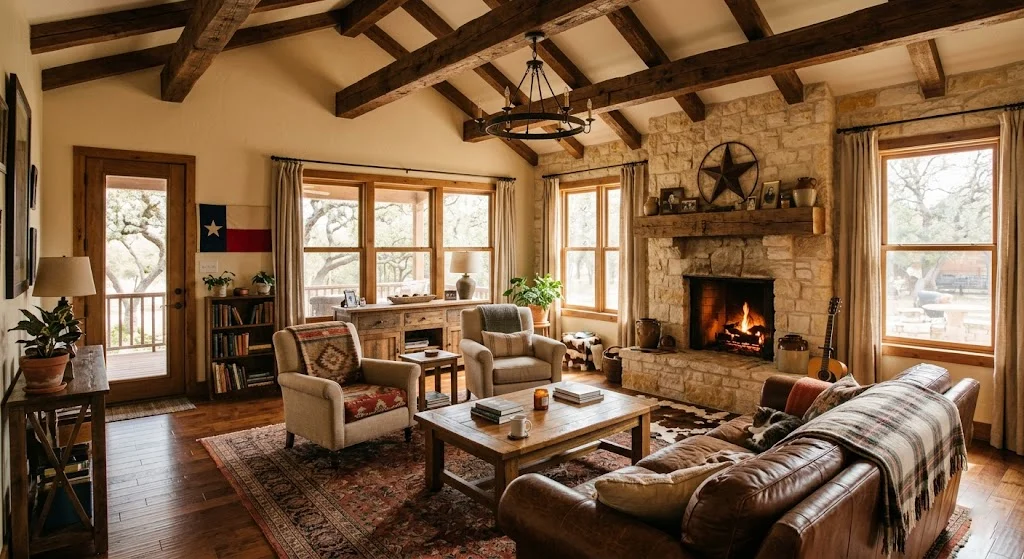
The vaulted wood-beam ceilings are the interior’s signature feature. They pull the eye upward, make every room feel larger than it is, and add the kind of warmth that no painted drywall ceiling can match. Natural light comes through at angles that shift through the day, keeping the space from ever feeling heavy or closed-in.
The Music & Memorabilia Room

This is the room that defines the house. Rodriguez dedicated a full room to his music career — not as a trophy display, but as a living record of his journey. Instruments, photographs, awards, and memorabilia fill the space. It’s where the public story and the private man meet. For anyone who cared about his contribution to country music, spending time in this room would feel like reading his biography in three dimensions.
Bedrooms
The home has four bedrooms. They’re built around comfort and rest — not square footage or architectural showmanship. Each room is private, well-lit, and suited to a household that valued family time over entertaining guests. Rodriguez and his wife Debbie shared this space with their daughter Aubry, and the bedrooms reflect that family-first priority.
Living Room
The living room is a gathering space rather than a statement piece. Natural light pours in and the proportions feel calm. It’s where Rodriguez spent quiet time with his family — playing guitar, talking, and existing away from the demands of a five-decade career. Nothing in the room demands your attention. Everything in it invites you to stay.
Key Features
- 4 bedrooms
- Traditional limestone exterior
- Vaulted wood-beam ceilings
- Dedicated music and memorabilia room
- Natural light throughout all main rooms
- Proximity to Medina River and Sabinal area
- Private, low-traffic neighborhood
- Far West Side / Hill Country outskirts location
- Comfortable family-oriented layout
Exterior & Outdoor
The property’s outdoor character comes from its surroundings rather than manicured landscaping. The Hill Country terrain does the work — open land, natural vegetation, and the kind of quiet that money can’t manufacture in a city. It’s the environment Rodriguez grew up in, and it’s the environment he chose to return to.
The proximity to the Medina River gives the property a natural connection to water and wildlife. Rodriguez spent much of his youth near this landscape. Having it close in his final years wasn’t a luxury upgrade — it was a homecoming. The outdoor space is modest but meaningful: not a resort, but a place where a man who earned his living on stage could simply be still.
Other Properties
| Property | Location | Estimated Value | Era | Notes |
|---|---|---|---|---|
| San Antonio Home | Far West Side, TX | ~$560,000 | Final years | Limestone, 4 bed, music room |
| Nashville Farm | Nashville, TN | ~$150K–$200K at purchase | Late 1970s | 27 acres, 100-year-old log cabin |
| Childhood Home | Sabinal, TX | Sentimental value | Childhood | Four-room house, family of 10 |
Net Worth & Income
Rodriguez’s net worth at his passing in 2025 was estimated at approximately $5 million. For a man who arrived in Nashville with $14, that figure tells a story of sustained, disciplined work across five decades rather than a single windfall.
His income came from multiple streams: album sales across 26 studio records, touring revenue from performances in the U.S., Mexico, Canada, South Korea, England, Poland, and Switzerland, and ongoing royalties from a catalog that includes six No. 1 hits. He signed with Mercury Records in the early 1970s and later with Capitol Records in 1987. His last major charting single was “I Didn’t (Every Chance I Had)” in 1988, which reached No. 12 — but the live performance income and royalties continued long after the chart activity slowed.
Rodriguez invested modestly in real estate, primarily in Texas. He never pursued the kind of wealth accumulation that his chart success could have supported. That was a choice, not a limitation.
Family & Lifestyle
Rodriguez’s final marriage was to Debbie McNeely, a hair salon owner from San Marcos, Texas. They married in 1998 and remained together until his death in 2025. Their daughter, Aubry Rae Rodriguez, was born in April 1998. By all accounts, Rodriguez spent his final years playing guitar at home, hosting close family, and living far from the media attention his career once generated.
He had been married twice before. His second marriage in 1995 was to Lana Nelson, daughter of Willie Nelson, and lasted seven months. His first was to Linda Diann Patterson, a flight attendant from Georgia. The marriage to Debbie was the stable, lasting one — and the household they built together in San Antonio reflected that stability.
Rodriguez’s lifestyle in his later years was quiet by design. He had no interest in the celebrity maintenance circuit — the events, the image management, the public presence for its own sake. He played music because he loved it. He lived in Texas because that’s where he was from. The house matches that straightforwardly.
Final Remarks
Most celebrity home articles are really about wealth as a scoreboard. This one isn’t. Johnny Rodriguez’s San Antonio home is worth covering precisely because it doesn’t look like what you’d expect from a country music pioneer with six No. 1 hits and 45 charted singles. It looks like a home built by a man who knew exactly what he valued and stopped performing for the room the moment he walked through the front door.
The limestone walls are South Texas. The music room is his whole career made physical. The four bedrooms are his family. The location, close to Sabinal and the Medina River, is the answer to the question of why he came home. Not because Nashville rejected him. Because Texas was always the point.
FAQ
How much was Johnny Rodriguez house worth?
His San Antonio home was estimated at approximately $560,000. He also owned a 27-acre farm with a 100-year-old log cabin in Nashville, Tennessee, purchased in the late 1970s for an estimated $150,000–$200,000.
What style was Johnny Rodriguez’s house?
Traditional South Texas — limestone exterior, vaulted wood-beam ceilings, and a warm, family-oriented interior. The design prioritized comfort and personal meaning over architectural display.
Did Johnny Rodriguez have a music room in his house?
Yes. He dedicated a full room to music and memorabilia — instruments, photographs, awards, and career artifacts from his five-decade career in country music.
Who designed Johnny Rodriguez’s house?
No specific designer has been publicly credited. The home reflects Rodriguez’s personal aesthetic: practical, grounded, and tied to South Texas building traditions.
What was Johnny Rodriguez’s net worth?
His net worth was estimated at approximately $5 million at his passing in May 2025, built through album sales, touring, and royalties from a catalog that includes six No. 1 country hits across 26 studio albums.