Outdoor holiday lights are one of the season’s pleasures, and one of its most rushed jobs. Strings come out of storage boxes, a ladder goes up against the gutter, and the display is finished in an afternoon. Most problems come from that rush: indoor lights used outside, damaged strings plugged in anyway, cords stapled through, and circuits loaded past their limits. None of the safety steps below take long, and together they cover the ways holiday lighting actually goes wrong — damaged wiring, water and electricity, overloaded outlets, and falls from ladders. The same unhurried approach that makes a porch display safe to look at also makes it safe to run, as the Halloween porch and entryway decor guide shows for the autumn season.

Start With the Label: Outdoor-Rated Means Outdoor
The single most important check happens before anything is unpacked: every light string, extension cord and timer used outside must be rated for outdoor use. Manufacturers label products clearly — “for outdoor use”, “indoor use only”, or both — and the distinction is not marketing. Outdoor-rated lights and cords have insulation and construction designed to handle moisture, cold and sun exposure; indoor products do not, and using them outside invites cracked insulation, shorts and shocks.
The rule applies to the whole chain, not just the lights. An outdoor light string fed by an indoor extension cord is still an unsafe setup. Multi-outlet strips and timers follow the same rule: if it sits outside, it must be outdoor-rated.
Inspect Every String Before It Goes Up
Storage is hard on light strings. Before hanging, lay each string out and check it along its full length:
- Frayed, cut or cracked insulation anywhere on the wire.
- Cracked or broken sockets, and sockets with exposed contacts.
- Loose or damaged plugs, bent prongs, or wires pulling out of the plug.
- Bulbs that are broken or missing — replace like-for-like with the correct type and wattage.
A damaged string should be discarded, not taped up and used one more season. Electrical tape over a frayed section is not a repair. Testing each string on the ground, plugged into an indoor outlet, is far easier than troubleshooting a dead section fifteen feet up a ladder.
Ladder Safety: The Part That Sends People to Hospital
More holiday-lighting injuries come from ladders than from electricity. The basics are well established and worth following exactly:
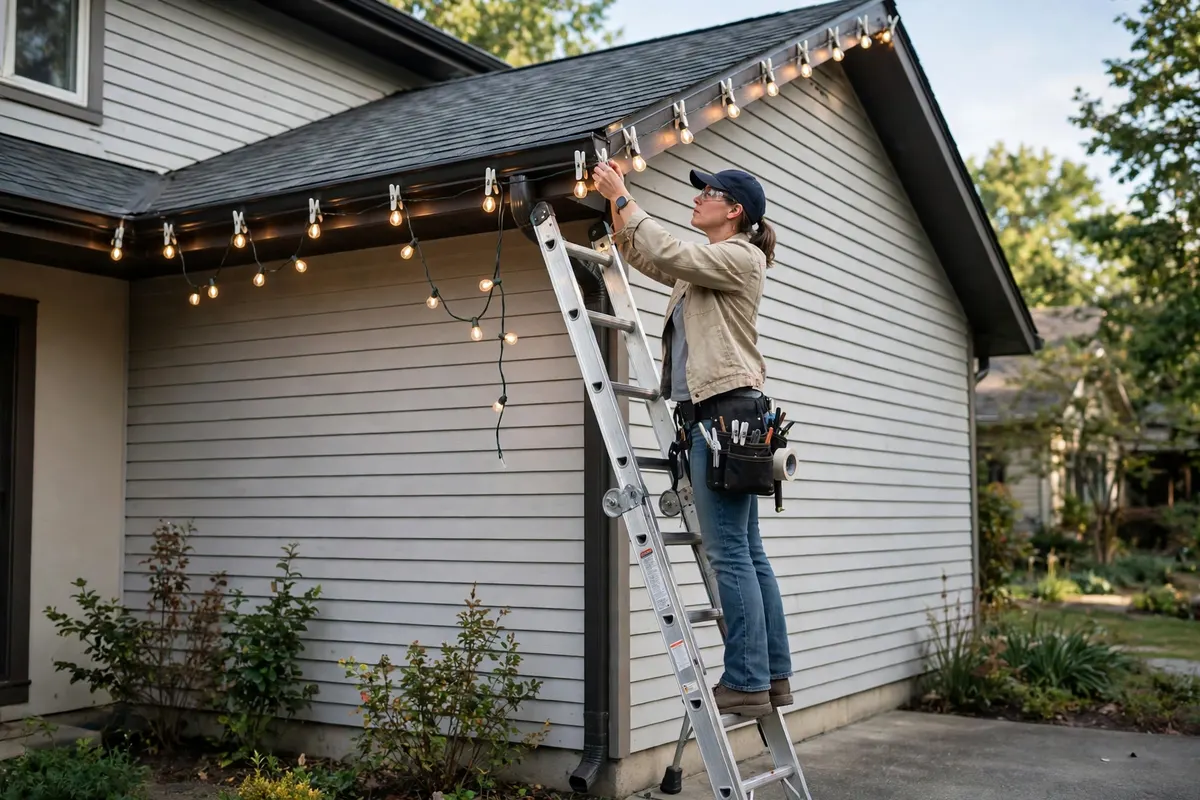
- Set the ladder on firm, level ground — never on ice, loose gravel or a wobbly surface — and check that it is fully open and locked, or properly angled and footed if it is an extension ladder.
- Maintain three points of contact while climbing and working: two hands and a foot, or two feet and a hand.
- Never stand on the top rungs of a step ladder or the top section of an extension ladder.
- Keep the work in front, not to the side — leaning out to reach one more clip is how ladders tip. Climb down and move the ladder instead.
- Work in daylight and dry weather. Wet rungs, wind and fading light all raise the risk, and there is no deadline on a light display that justifies any of them.
- Wear shoes with grip, keep tools in a belt or bucket rather than in hands while climbing, and have a second person foot the ladder on taller jobs.
Clips, Not Nails or Staples
Driving a nail or staple through a light string’s wire is a direct route to damaged insulation and a short circuit — sometimes immediate, sometimes weeks later when moisture reaches the nick. Purpose-made light clips cost little and solve the problem properly: they grip gutters, shingles or eaves without piercing anything, hold the string in a neat line, and come off cleanly in January.
Where clips cannot reach, insulated hooks or cable ties around a fixed point — never pinching the wire itself — do the same job. Any fixing that squeezes, pierces or sharply bends the cord should be avoided.
Power: GFCI Outlets, Sensible Loads and Timers
Outdoor receptacles should be GFCI-protected (ground fault circuit interrupter), which cuts power quickly if current leaks — the protection that matters most where electricity meets wet weather. Test the GFCI with its built-in test button before the season’s first use. In-ground and in-use covers that keep rain out of the outlet while a plug is inserted are the correct companion fittings.
Load discipline is the second half. Every light string and extension cord has a manufacturer limit for how many strings can be connected end to end — follow it rather than chaining strings until the plugs run out. Overloaded circuits and cords overheat quietly. Splitting a large display across two outlets, and choosing an extension cord rated for the load and the outdoor use, keeps everything within its design.
Timers finish the job: set the display to switch off at a set hour rather than running all night. Lights left on unattended for long stretches waste power and extend the window in which a fault could develop unnoticed. An outdoor-rated timer on the GFCI outlet is a simple, standard arrangement.
Cords: Routes, Walkways and Metal
Extension cords should run where they will not be walked on, driven over or pinched in doors and windows. Stepping on a cord repeatedly damages insulation from the inside. Keep cords out of puddles and low spots where water collects, and raise connections off the ground where practical.
Metal deserves a mention: gutters, downspouts and metal roofing conduct electricity, so cords and strings should not rest in direct, rubbing contact with them — clips that hold the string slightly off the surface handle this as a side benefit. Keep cords and lights clear of power service lines entirely; displays belong on the house, not near the drop from the street.
LED vs Incandescent: The Heat Difference
LED strings run far cooler than older incandescent sets, which is one reason they have become the default recommendation: a cool bulb against dry foliage, paper decorations or a wreath is a much smaller concern than a hot one. Incandescent strings still in service deserve extra care in placement — away from anything flammable, and never bunched or buried under garlands where heat can build. Whichever type is used, lights should never be left resting against dry leaves, curtains or decorations for long unattended periods, and indoor-rated sets should never migrate outdoors mid-season. The same respect for heat sources runs through winter home care generally — the rules for space heater safety make a good companion read.
Take-Down and Storage
Safety work ends in January. Take strings down in dry daylight with the same ladder care used to hang them, inspect each one as it comes off — damage found now is a string replaced cheaply in the sales rather than discovered next December — and coil loosely rather than winding tightly around a hand, which twists and strains the wire. Store strings dry, in a closed box, off a damp floor, with bulbs protected from crushing. A few minutes at take-down is what makes next year’s inspection a formality instead of a discovery.
Frequently Asked Questions
Can indoor Christmas lights be used outside if the weather is dry?
No. Indoor-rated lights lack the insulation and moisture resistance for outdoor use, and weather can change while the display is up. Only products labelled for outdoor use should be installed outside — including the extension cord and timer feeding them.
How many light strings can be connected together?
Follow the manufacturer’s limit printed on the string’s packaging or tag — it varies by product and bulb type. Chaining strings beyond that limit overloads the wire. Splitting a display across two outlets is the safe way to grow it.
Should outdoor lights be plugged into a GFCI outlet?
Yes. GFCI protection cuts power quickly if current leaks, which is exactly the protection needed where electricity meets wet weather. Test the outlet’s test button before the season and use an in-use cover that keeps rain out while the plug is inserted.
Are LED holiday lights safer than incandescent ones?
They run much cooler and use less power, which reduces both heat concerns near decorations and the load on the circuit. The other rules still apply unchanged: outdoor rating, inspection before hanging, clips instead of staples, and a timer.
Is it safe to leave holiday lights on all night?
It is better not to. A timer that switches the display off at a set hour saves power and avoids leaving lights running unattended for long stretches. Displays should also be turned off in severe weather.
What is the safest way to attach lights to the roofline?
Purpose-made light clips that grip the gutter, shingle or eave without piercing the wire. Nails and staples can cut insulation and cause shorts, and any fixing that pinches or sharply bends the cord should be avoided.