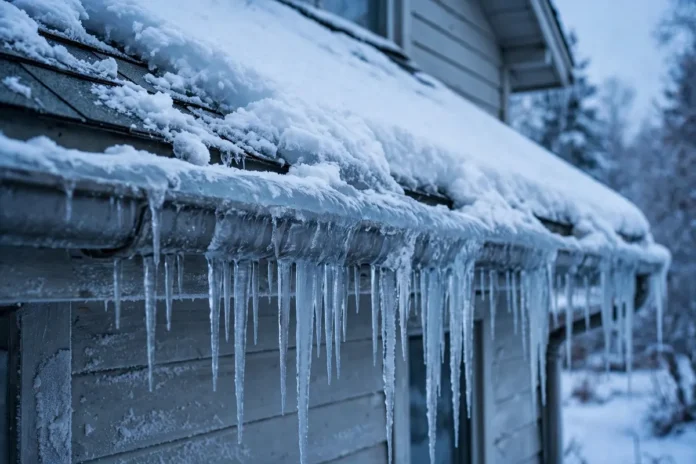
An ice dam announces itself in a familiar way: a thick ridge of ice along the edge of the roof, icicles hanging from the gutters, and — the part that matters — a stain spreading across a ceiling or water dripping down an interior wall. Ice dams cause some of the most frustrating leaks in cold-climate homes because they are not really a roofing problem. They are a heat problem, and they start inside the attic. To prevent ice dams properly is to fix the attic — before the snow settles in, not after the first thaw.

What an Ice Dam Is and How It Forms
Heat from the living space escapes into the attic and warms the roof deck from below. Snow lying on that warmed roof melts, even on a cold day, and the water runs down the slope. At the eaves — the overhanging edge of the roof, which has no heated room beneath it — the deck stays cold, and the meltwater freezes again. Freeze by freeze, a ridge of ice builds up along the edge: the dam.
Behind the dam, a pond of liquid water collects. Roofing shingles are designed to shed running water, not to hold back standing water, so the pond works its way under the shingles and underlayment and into the house. The decorative icicles are simply the dam overflowing at its edges — and a row of large ones is a reliable sign that a dam is forming.
The three ingredients are always the same: snow on the roof, a roof surface warmed unevenly from below, and a freezing edge. Remove the uneven warmth and the dam never forms.
The Damage a Dam Can Do
Water that backs up under shingles does quiet, expensive damage. It stains ceilings and walls, peels paint, and rots the roof deck and the tops of exterior walls. It soaks insulation, and wet insulation insulates poorly — letting more heat escape and feeding the next dam. Heavy ice bends and pulls gutters away from the fascia, and falling icicles are a genuine hazard below the eaves.
The Real Fix Is in the Attic
Because the dam is caused by heat reaching the roof, the lasting cure is to keep heat in the living space and the attic cold. Three jobs do it, in this order.
1. Air-seal the attic floor
Insulation slows heat; air sealing stops it. Warm indoor air rises and leaks into the attic through dozens of bypasses: the attic hatch, gaps around pipes and chimneys, the tops of interior walls, and the holes cut for recessed lights and wiring. Sealing these with foam, caulk and weatherstripping — and sealing the hatch itself, often little more than a thin sheet of plywood — removes the largest share of the heat that feeds a dam. Recessed lights deserve special attention: older fittings leak a great deal of air and add heat of their own.
2. Add insulation to the recommended depth
With the leaks sealed, insulation keeps the remaining heat down. Attics in cold climates need a deep, even layer; the common faults are thin spots, gaps at the hatch and eaves, and insulation compressed by stored boxes. Materials, R-values and installation are covered in full in this attic insulation guide, the natural companion to this article.
3. Keep the ventilation working
A cold roof deck is the goal, and ventilation is how it stays cold: outside air enters at the soffit vents under the eaves, flows up along the underside of the deck, and exits at ridge or roof vents, carrying away stray warmth. It fails quietly when insulation is pushed into the eaves and blocks the soffit vents. Baffles — simple channels fitted between the rafters — keep an air path open above the insulation at the edge. Balanced intake and exhaust matters: plenty of ridge vent with blocked soffits does almost nothing.

Before the Snow: Gutters, Shingles and Flashing
The attic work is the cure, but a short roof check before winter — this roof winter check covers the full seasonal list — removes the aggravating factors:
- Clean the gutters and downspouts. Meltwater that cannot drain away sits at the cold edge of the roof exactly where ice forms.
- Check shingles and flashing for damage, curling or gaps, especially in valleys and around chimneys and vents, where backed-up water finds its way in first.
- Trim overhanging branches where that can be done safely — they shade the roof edge colder and drop debris into the gutters.
During Winter: The Roof Rake and Stopgaps
Even a well-sealed attic can grow a dam in an exceptional winter. After heavy snow, a roof rake — a long-handled tool used from the ground — can pull snow off the first few feet of roof above the eaves, removing the raw material the dam feeds on. The rule that goes with it is absolute: never climb onto an icy roof. Work from the ground, gently, without gouging the shingles.
For a dam that has already formed and is leaking, calcium chloride ice-melt socks are the standard stopgap: fill a leg of old pantyhose or a fabric tube with calcium chloride, lay it across the dam, and it melts a channel through the ice that lets the ponded water escape. Use calcium chloride, not rock salt, which is less effective and harder on roofing and plants. This is damage control, not a cure — the attic work is still waiting for spring.
What Not to Do
Some popular responses make things worse:
- Do not chip at the ice with an axe, hammer or hatchet. It is easy to cut through the ice and the shingles beneath it, trading a winter leak for a spring roof repair.
- Do not pressure-wash a dam. Pressure drives water under the shingles and adds to the pond behind the dam.
- Do not salt the whole roof. Scattering ice melt across shingles damages the roofing and the plantings below, and does nothing about the ponded water that is actually leaking.
Heat Cables: A Last Resort, Installed Early
Electric heat cables zigzagged along the eaves can keep channels open through the ice, and in stubborn cases — a low-slope roof, a north-facing valley — they have their place. But they treat the symptom, cost electricity all winter, and must be installed before the season, not after the dam has formed. They are the last resort after air sealing, insulation and ventilation, not a substitute for them.
When to Call a Professional
Some situations call for a roofing or insulation professional: leaks that return every winter in the same place; a long row of icicles along the eaves year after year, which signals a serious heat-loss problem; visible sagging or water damage in the attic; and any dam threatening electrical fittings below. An insulation contractor’s blower door test finds the air leaks precisely, and a roofer can judge whether the eaves have a proper ice-and-water shield membrane beneath the shingles. Houses that grow icicles every year are telling their owners something; the fix is in the attic, and it is permanent.
Frequently Asked Questions
What causes an ice dam on a roof?
Heat escaping from the living space into the attic warms the roof deck and melts the snow. The meltwater runs down to the cold eaves, refreezes, and builds a ridge of ice that traps water behind it, which eventually leaks under the shingles.
How can ice dams be prevented permanently?
By keeping the roof deck cold: air-seal the attic floor around hatches, pipes and light fittings, insulate to the recommended depth, and keep soffit vents clear so ventilation can carry stray heat away.
Is it safe to remove an ice dam by chipping at it?
No. Chipping with an axe or hammer commonly damages the shingles beneath the ice and can turn a leak into a roof replacement. A roof rake from the ground and calcium chloride socks are the safe homeowner options.
Do heat cables solve ice dams?
Heat cables melt channels through ice at the eaves, but they treat the symptom, use electricity all winter and must be installed before the season. They are a last resort after air sealing, insulation and ventilation.
What are ice-melt socks and how do they work?
A fabric tube — often a leg of pantyhose — filled with calcium chloride and laid across the dam. The calcium chloride melts a channel through the ice, allowing ponded water to drain off the roof.
What are the signs that an ice dam is forming?
A thick ridge of ice along the eaves, large icicles hanging from the gutters, and water stains or drips on ceilings and exterior walls during a thaw. Recurring icicle rows in the same place each year point to heat loss in the attic.