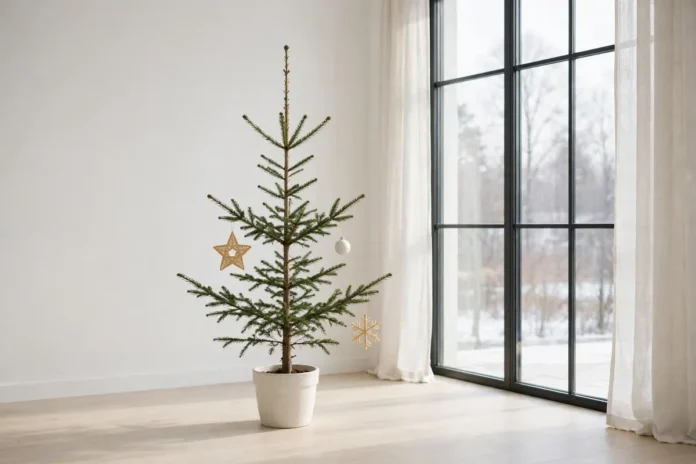
The Scandinavian approach to Christmas decorating starts from the conditions of a northern winter: short days, long evenings, and homes that need warmth without noise. Where maximalist decorating layers colour on colour until every surface is covered, the Nordic version does almost the opposite — a calm base of white and warm neutrals, natural wood, fresh greenery, and light treated as the main event. The result is festive without being busy, and it photographs beautifully, but its real virtue is practical: it is cheap to build from natural materials, kind to small rooms, and comes down in January without a storage crisis. This guide sets out the palette, the lighting rules, the materials and the table, and what the style deliberately leaves out.
The Palette: White, Wood, Greenery and One Red Accent
Scandinavian Christmas decor is built on a strict, quiet palette. White and warm off-whites form the base — walls, linen, candles, painted wood — and natural wood in pale tones adds the warmth that pure white alone would lack. Fresh greenery, usually fir or pine, supplies the main colour. In the traditional version of the style, red appears as a single small accent: a ribbon on a wreath, a checked cushion, berries in a vase, the trim on a straw ornament. Used that sparingly, red reads as a deliberate note rather than a theme.
The discipline matters more than any single item. Because the whole scheme rests on so few colours, anything outside it — gold glitter, bright blue, novelty prints — stands out immediately and breaks the calm. Shopping becomes simple: an item either fits the palette and the materials, or it stays in the shop.
Light Is the Centrepiece
In a style shaped by dark winters, light is not an accessory; it is the decoration everything else supports. The Nordic look comes from many small points of warm light rather than one bright source: candles grouped on a table and a sill, a string of small warm-white lights along a shelf, a paper star glowing in a window. Each light is modest on its own; together they change the room’s whole mood at dusk.
Safety shapes how the light is done. LED candles are the practical default near anything flammable — fabrics, paper stars, dried greenery, curtains — because they give the flicker without the flame, and battery versions can sit where no socket exists. Real candles have their place, but only on stable, heatproof holders, on surfaces where they cannot be knocked, kept away from curtains, greenery, paper and soft furnishings, and never left burning unattended or when the room is empty. Strings of electric lights follow the same logic: checked before use, kept clear of heat sources, and switched off overnight and when the house is empty.
Paper Stars in the Windows
The paper star lantern is the style’s signature piece: a large, folded white or natural paper star, lit from inside with a low-heat bulb or LED, hung in a window where it glows to the street and the room at once. One star per window is the usual measure, in the same size family across a facade. They store flat, cost little, and because they hang in the window they decorate without taking a single surface. The bulb inside must be the cool-running type the star is made for, and paper must never be placed against a hot bulb or an open flame — the same rule that keeps all paper decor away from candles anywhere in the house.

Natural Materials and Hygge Layering
What the style lacks in colour it returns in texture. Straw is the traditional material: woven straw ornaments, stars and small figures on the tree, and straw wreaths on doors — pale gold, matte, and handmade in character. Wood appears everywhere it can: turned wooden candle holders, simple wooden figures, a wooden bead garland, the tree stand hidden under a woven basket or a plain linen cloth. Woven textiles carry the pattern load — a checked or striped runner, cushion covers in wool and linen.
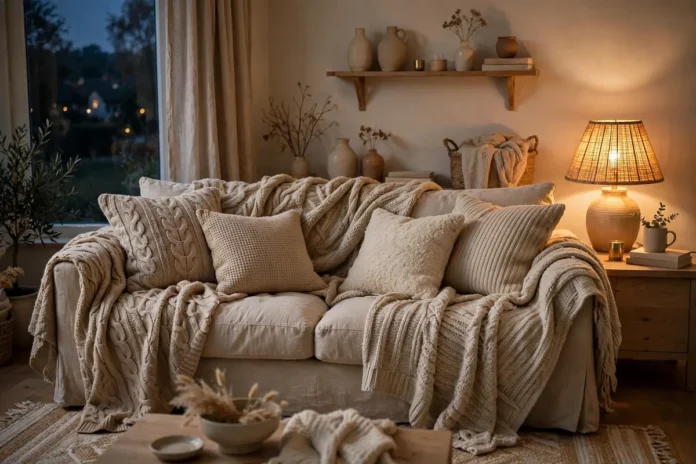
Layered over the seating, this becomes hygge in its decorating sense: sheepskin-style throws over chair backs, wool cushions in the palette’s neutrals, a folded blanket on every seat that gets used. The layering is all textiles, so it warms the room literally as well as visually, and folds away flat in January.
Greenery Kept Simple
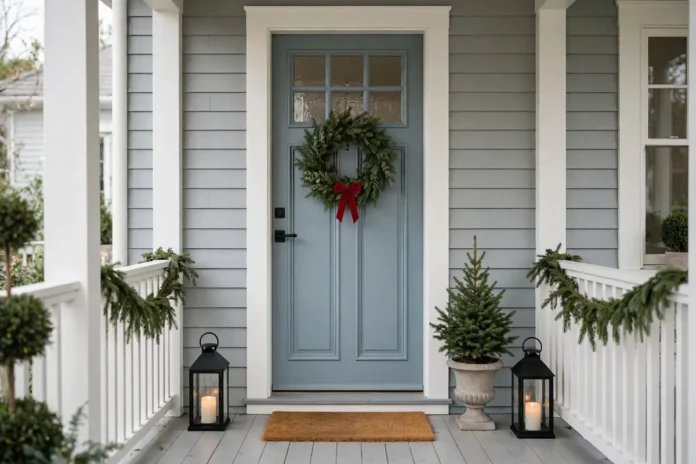
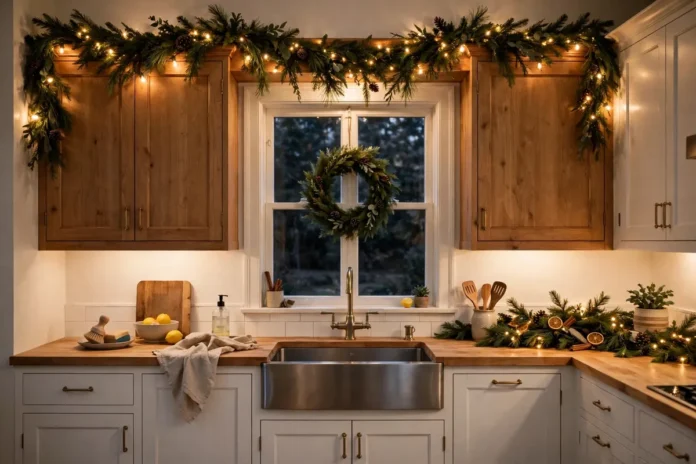
Greenery in this style is used plainly, without tinsel, bauble clusters or sprayed effects. A single fir garland along a shelf or a mantel, left unadorned or carrying a few wooden beads. Branches in a tall vase — fir, pine, or bare winter branches — standing in a corner or beside the hearth, with nothing hung on them or one or two straw ornaments at most. A wreath of plain fir on the door, finished with the palette’s one red ribbon.
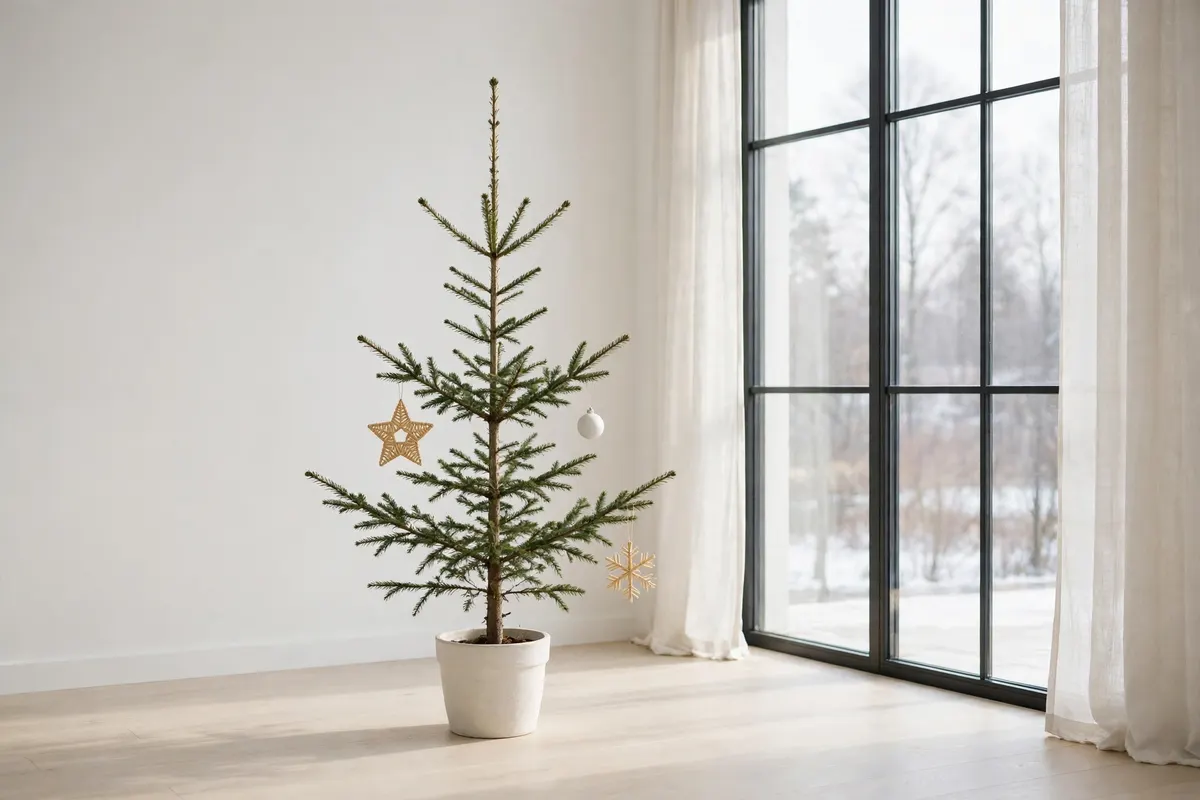
The tree follows the same restraint: usually a small real tree rather than a large artificial one, dressed with few ornaments — white, straw, wood and perhaps a string of small lights — with space left between them. The step-by-step order in these christmas tree decor ideas still applies, but each stage stops much earlier; the Scandinavian tree is finished when it looks half-dressed by fuller standards.
The Table: Linen, Wood, One Candle Group
The Scandinavian Christmas table is set the way the rooms are decorated: a plain linen cloth or runner, wooden or simple white tableware, cloth napkins, and a single centrepiece — one group of candles on a wooden tray with a little greenery laid around their bases, holders stable and flames kept well clear of the greenery, the linen and anything paper. No scattered confetti, no tinsel, no second and third arrangements competing down the table’s length. Everything on the table has a job, and the candlelight does the rest.
Made for Small Homes
Few decorating styles suit small homes as naturally as this one. It adds almost nothing freestanding: the stars hang in windows, the greenery goes on shelves and doors, the warmth comes from textiles swapped onto furniture that is already there. A small room decorated this way gains atmosphere without losing floor or surface space, and the one-box storage reality of a small flat is easy to honour, since ornaments are few and textiles fold flat. The placement strategies in these small space holiday decor ideas — decorate the architecture, swap rather than add, keep half of every surface clear — are, in effect, the same rules the Nordic style has always worked by.
What to Skip
The style is defined as much by its refusals. Plastic shine and glitter, because every material is meant to be natural and matte. Mixed bright colours, because the palette is the calm. Novelty items and figurine collections, because surfaces stay mostly clear. And the urge to cover every surface: a room in this style should still show plenty of plain white, plain wood and empty space between its decorations. If a room looks full, it has already left the style behind.
Frequently Asked Questions
What colours define Scandinavian Christmas decor?
White and warm neutrals as the base, natural pale wood, and fresh green fir or pine. In the traditional version, red is used as one small accent — a ribbon, berries, a checked cushion — rather than as a main colour.
How is candlelight used safely in this style?
LED candles are the default near fabrics, paper stars, curtains and greenery. Real candles belong only on stable, heatproof holders, away from anything flammable, and must never be left burning unattended or in an empty room.
What are Scandinavian Christmas ornaments made of?
Natural, matte materials: woven straw stars and figures, turned wood, paper, linen and wool. Plastic shine, glitter and novelty prints are exactly what the style leaves out.
What is a paper star lantern?
A large folded paper star, lit from inside with a cool-running bulb or LED, hung in a window. It glows to both the room and the street, stores flat, and must always be kept away from hot bulbs and open flames.
Does Scandinavian Christmas decor suit a small home?
Very well. The decorations hang in windows, rest on shelves and doors, or arrive as textile swaps on existing furniture, so a small room gains atmosphere without losing space — and the few ornaments store in a single box.
How is the Scandinavian Christmas tree decorated?
Usually a small real tree with few ornaments — white, straw and wood, plus small warm lights — spaced apart rather than crowded. By fuller decorating standards it looks deliberately half-dressed, and that restraint is the point.