The kitchen is the hardest room in the house to decorate for Christmas, for one simple reason: it still has to work. December kitchens host more cooking than any other month, and every decoration on a counter is workspace lost, a splash risk, or worse, a hazard near heat. The answer is not to skip the kitchen — it is often where guests gather most — but to decorate it on different terms: decorate the zones cooking never touches, swap textiles instead of adding objects, and treat safety rules as non-negotiable. Done that way, the kitchen looks festive and still turns out a full holiday meal.

Decorate the Zones Cooking Never Touches
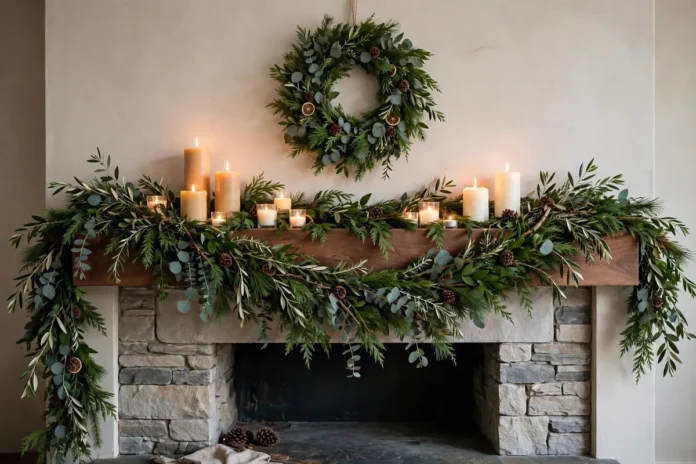
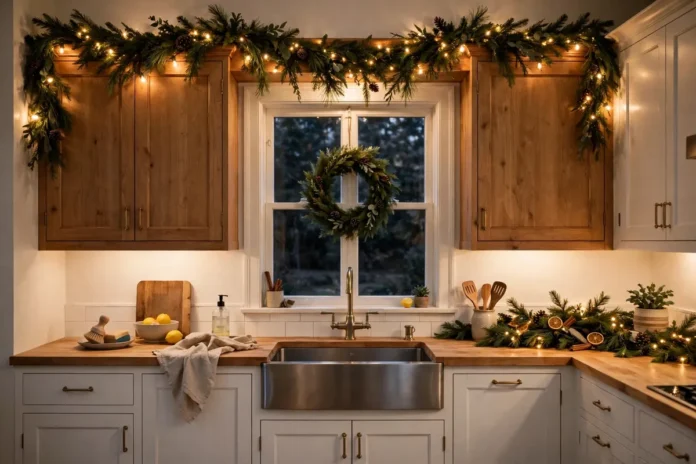
Every kitchen has areas that stay clear of heat, steam and splashes, and those are the decorating zones. The tops of wall cabinets are the prime example: dead space for cooking, but a perfect ledge for a garland. A plain fir garland laid along the cabinet tops, threaded with warm string lights, puts the greenery at the highest, safest point in the room, well above the range hood’s heat path and far from any burner. Battery-powered lights are the practical choice up there, since no cable needs to trail down to a socket.
The window over the sink is the second natural spot. A small wreath hung on the inside of the glass — on a suction hook or a ribbon looped over the frame — is seen from inside and out, sits above a wet zone where it harms nothing, and never competes for counter space.
Open Shelves: Swap, Don’t Add
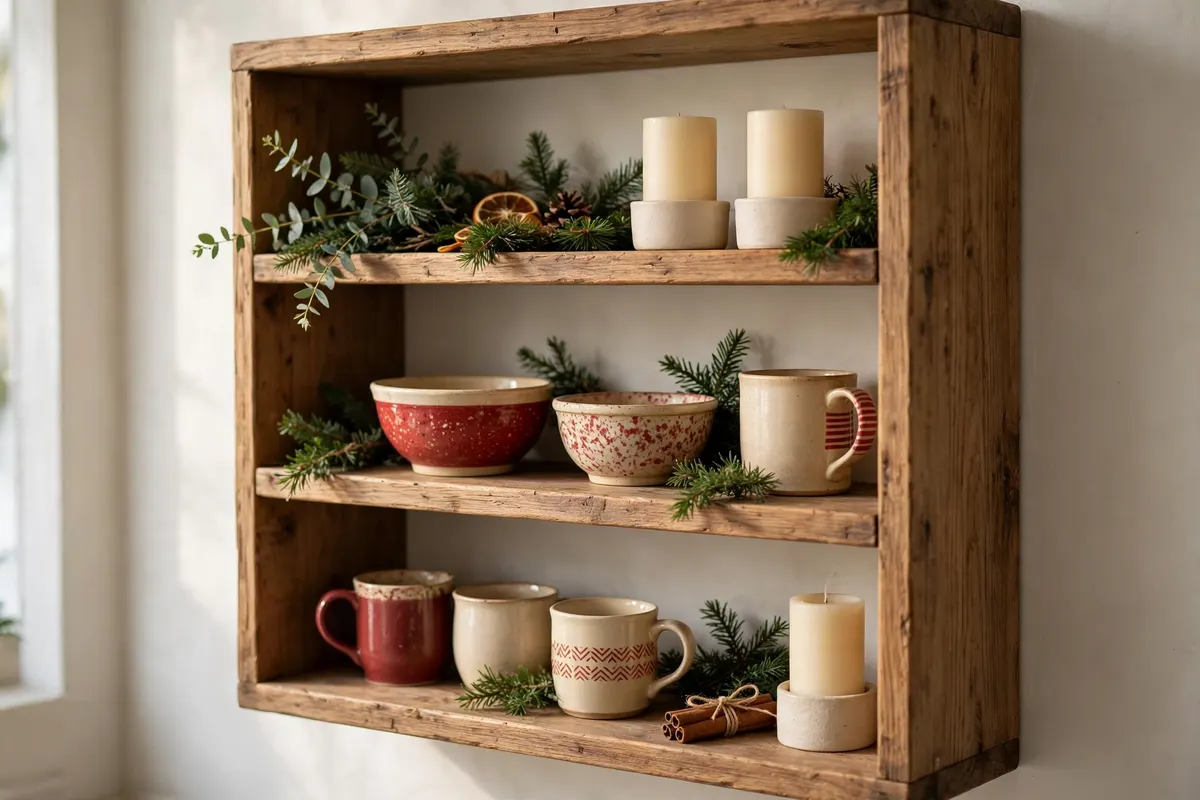
Open shelving gets its Christmas look through substitution rather than addition. Everyday items come off and seasonal versions go on in the same footprint: plain mugs replaced by a set in one festive colour, neutral bowls swapped for ceramics in the chosen palette, a wooden board joined by a piece of greenery laid behind it. One colour family plus the room’s existing neutrals, repeated across the shelf, keeps the display calm instead of cluttered.
Closed kitchens can use the same trick on one shelf or a stretch of counter that cooking does not claim, such as beside the fridge. Objects are swapped in, not added on top, so surfaces end the season exactly as full as they began it.
One Styled Spot: The Island End or a Serving Counter
If the kitchen has an island, its far end — away from the hob and the prep sink — can carry one styled arrangement: a tray holding a bowl of ornaments, a sprig of greenery and one candle in a jar, lit only when someone is in the room and never while cooking is under way around it. Without an island, the corner of a serving counter or a sideboard does the same job. One arrangement reads as a centrepiece; decorations scattered along every counter read as obstacles.
The placement test is practical: the tray must not narrow the walkway between cooker and sink, sit where hot pans land, or block the oven door’s swing. A spot that fails any check is the wrong spot.
Textile Swaps That Do the Heavy Lifting
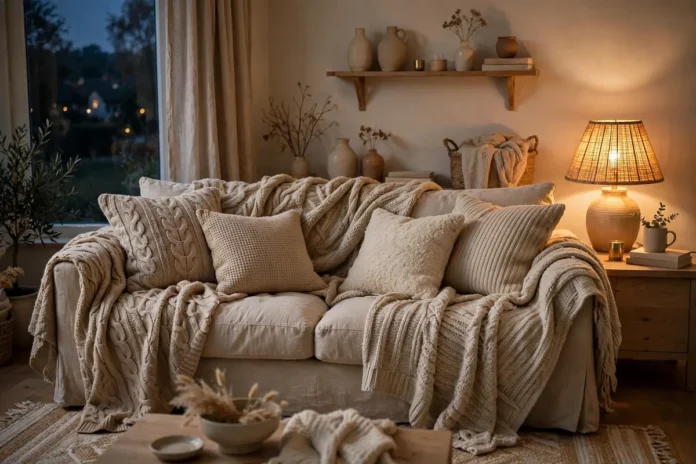
Textiles are the kitchen decorator’s hardest-working tool because they change the room’s whole look while adding nothing to it. Tea towels in a seasonal colour or simple festive print, hung where tea towels already hang, are the fastest change of all. Add oven mitts swapped for a holiday pair, a runner along an island or down a breakfast table, and cushion covers on stools or a breakfast-nook bench in the same palette, and the room gains its Christmas character from things that would be there anyway.
The one caution is placement: towels and mitts belong on their hooks, at their usual distance from the hob — never where they can fall or swing onto a hot surface.
A Small Tree — Only Where It Is Safe
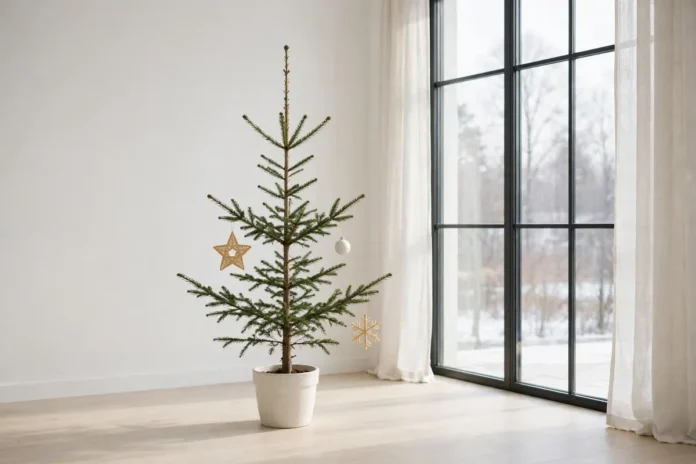
A miniature countertop tree or a vase of bare branches strung with a few ornaments can work in a kitchen, but placement decides everything. It belongs at the far end of a counter, on a windowsill away from the cooker, or on a side table in the eating area — always well away from the stove, the kettle’s steam and the splash zone behind the sink, with any cable routed where it cannot cross a hob, hang near a burner or dangle into the sink. If the only available surface is near the cooking zone, skip the tree: the wreath and garland already carry the room, and the full-size tree in the living room — see these christmas tree decor ideas — does the rest.
Fridge and Hardware Touches
Small, flat, fixable details finish a kitchen without claiming any surface at all. A ribbon tied on a cabinet handle or two — on the handles furthest from the cooker — adds colour at eye level. The fridge door takes magnet-friendly decor: festive magnets holding the season’s cards, or a child’s drawing given pride of place.
Light and Scent, the Safe Way
Warm string lights along a shelf edge or under the cabinet tops give a kitchen its evening glow — with two rules. First, lights and cables stay clear of the hob, the oven and any hot surface. Second, they are switched off when the kitchen is empty and overnight; a timer plug makes that automatic.
For scent, the stove itself does the work more safely than any candle near the burners. A simmer pot — water with orange peel, cinnamon sticks, cloves and a sprig of pine, kept at the lowest heat — perfumes the whole kitchen while it is attended. It must never be left simmering unattended or allowed to boil dry, and it comes off the heat when cooking finishes. The wreath and garland add pine scent for free.
The Strict Safety List
Kitchen decorating has a short list of rules that do not bend:
- Nothing hangs over or beside burners — no garland, no towels, no decorations within reach of a flame or a hot ring.
- No garland in the range hood’s heat path or draped where steam and grease rise from the hob.
- No loose textiles by the hob; towels and mitts stay on their hooks when not in use.
- Candles are never placed near burners, curtains or paper decor, are kept on stable holders, and are never left burning in an empty room.
- Walkways stay clear, the oven door’s swing stays clear, and nothing is stored on top of the cooker or inside the oven as decoration.
- Cables for lights never cross the hob, the sink or a walkway.
- Anything flammable — paper, fabric, dried greenery — stays away from the stovetop, the oven, heaters and open flames at all times.
The same caution applies where guests are fed: the hosting setups in this guide to the dining room holiday hosting keep candlelight and greenery at a safe distance from heat for the same reasons.
Storage and the January Reset
Kitchen decor earns its place when it stores as easily as it went up. The garland and lights coil into one box, the textiles fold flat into a drawer, and the shelf swaps simply reverse — seasonal ceramics out, everyday ones back. The reset takes minutes: wreath off the window, ribbon off the handles, tray emptied and stored.
Frequently Asked Questions
Where is it safe to put Christmas decorations in a kitchen?
On the zones cooking never touches: along the tops of wall cabinets, on the window over the sink, on open shelves as swaps, and on one tray at the far end of an island — always well away from the hob and the range hood’s heat path.
Can a Christmas tree go on a kitchen counter?
Only a small one, at the far end of a counter well away from the stove, kettle steam and splashes, with any cable routed clear of the hob and sink. If the only surfaces are near the cooking zone, skip it.
How can a kitchen look festive without losing counter space?
Swap rather than add: seasonal tea towels, oven mitts, a runner and cushion covers change the room’s look while occupying no new space. One palette keeps it calm, and a single styled tray is the focal point.
Are string lights safe in a kitchen?
Yes, kept clear of the hob, oven and hot surfaces, with cables that never cross the cooker, sink or a walkway. Battery lights avoid cable problems altogether. Switch them off when the kitchen is empty.
What should never be decorated in a kitchen?
Anything over or beside the burners, the range hood’s heat path, and the space in the oven door’s swing. Loose textiles should never hang by the hob, candles should never sit near burners or curtains, and nothing flammable belongs near the stovetop or any heat source.
How is festive scent done safely in a kitchen?
With a simmer pot on the stove — water, orange peel, cinnamon and cloves at the lowest heat — while someone is in the kitchen. It must never be left unattended or boil dry. The greenery adds pine scent without any flame at all.