Winter changes how a living room is used. The room that hosted quick conversations in summer becomes the place where whole evenings are spent — reading, watching films, talking, doing very little at all. Coziness in that setting rarely comes from buying a new sofa or repainting the walls. It comes from layering: soft textiles over hard surfaces, warm light over cool light, and furniture arranged so people naturally gather instead of spreading out. Most of the changes below cost little, take an afternoon, and come undone just as easily in spring.
Start With Textiles: Throws and Cushions
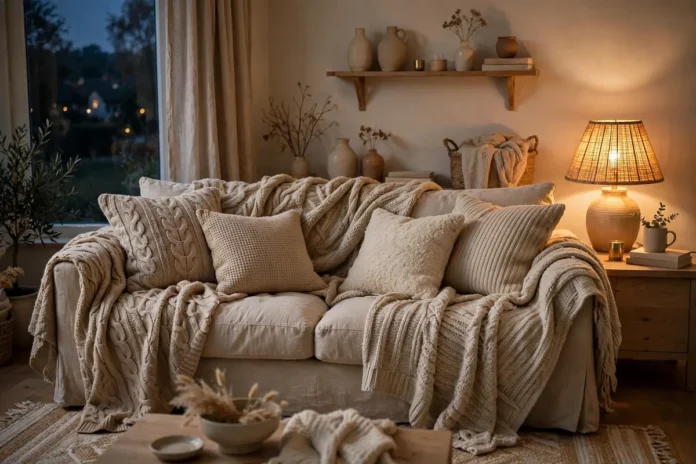
A single throw folded over the arm of a sofa does more for a room’s warmth — visual and actual — than almost any other object. The trick is layering rather than matching. A chunky knit throw over a smooth wool blanket, cushions in two or three sizes rather than one repeated size, and a mix of textures that invite touch: wool, knitted cotton, velvet, and linen all read differently and sit comfortably together.
Colour matters less than contrast in texture. A neutral sofa can carry cushions in deeper winter tones — rust, forest, ochre, charcoal — without any commitment to a new scheme. Keep the number honest, though. Cushions that have to be moved before anyone can sit down have stopped being comfort and become storage. Two or three per seat is plenty, with one throw per person who regularly uses the room, kept within arm’s reach rather than folded away in a cupboard.

Put a Rug Layer Underfoot
Hard floors are the quiet reason many living rooms feel cold in winter, whatever the thermostat says. A rug under the main seating area changes the sound of the room as much as the temperature — footsteps soften, voices carry less echo, and bare feet stop avoiding the floor.
Size is the common mistake. A rug that floats in the middle of the room, touching no furniture, makes the seating look stranded. The front legs of the sofa and armchairs should sit on the rug, which ties the group together into one warm island. Where a large rug is not an option, layering works here too: a smaller, thicker rug over a flat-weave base adds depth, and a runner along the path between the sofa and the door catches the worst of the cold route. Natural fibres such as wool feel warmest and wear well, though a good wool-blend is easier on a budget.
Warm the Lighting in Layers
Overhead lighting is the enemy of a winter evening. A single bright ceiling light flattens a room and pushes everyone toward switching it off and sitting in the dark instead. Layered light works the other way: a low lamp beside the reading chair, another near the sofa, and perhaps a small light on a sideboard, so the room glows at the edges rather than glaring from the centre.
Bulb temperature does much of the work. Warm bulbs — around 2,700K — echo firelight and lamplight; cool daylight bulbs undo every other cozy change in the room. For a fuller walkthrough of building light in layers, the guide to layered lighting ideas covers combinations for every room. In the living room, the simple rule is three sources at three heights, none of them the ceiling light.
Rearrange Furniture Toward the Fire
Summer layouts tend to face the television or the window. Winter layouts work better turned inward, toward a focal point — ideally the fireplace or hearth, where a real fire or even a candle grouping gives the eye somewhere warm to rest. Pulling the sofa and chairs closer together, and closer to the hearth, shrinks the room in the best way: conversation gets easier, throws get shared, and the unused corners stop mattering.
Where there is no fireplace, the same principle applies with a substitute focal point — a low coffee table with candles, a bookshelf wall, or simply the seating turned to face itself rather than the walls. Even rotating a rug and two chairs by a few degrees can change a pass-through space into a gathered one. Leave walkways clear, but do not let them dictate the whole plan.

Swap to Heavier Curtains
Windows are where winter gets in, thermally and visually. Sheer or lightweight summer curtains leave glass exposed, and a room with bare glass at night feels colder than it is — the black reflective surface reads as open space. Heavier, lined curtains drawn at dusk close the room in, soften sound, and genuinely reduce drafts on older windows.
Floor-length curtains hung close to the wall trap a layer of still air against the glass, which is where much of the benefit comes from. If replacing curtains is not on the cards, lining existing ones with inexpensive thermal lining fabric achieves most of the same effect. Velvet and heavy cotton blends also add the texture layer at the largest scale in the room.
Add Warm Colour Without Repainting
A winter palette does not require a paintbrush. Colour can arrive on the textiles already discussed — cushions, throws, a rug — and in smaller accents: a stack of books with warm-toned covers, a wooden bowl on the coffee table, dried branches or winter greenery in a vase, brass or copper in picture frames and lamp bases. These are the colours of low sun and firelight, and they sit naturally against most existing schemes.
The reversible nature is the point. Come spring, the deep-toned cushions rotate out and the room lightens again, which keeps winter changes feeling like a season rather than a renovation.
Set Up One Corner Properly
A whole room layered for winter is ideal, but one corner done properly delivers most of the benefit. A reading or television corner needs four things: a seat that supports a long sit, light positioned over the shoulder rather than in the eyes, a small surface within reach for a drink and a book, and a throw that lives there permanently. For readers building a dedicated spot, these cozy reading nook ideas go deeper on seating and shelving. A footstool or ottoman completes the corner — feet up is half of settling in.
Scent and Candles, With Care
Scent is the layer people notice last and remember most. Wood, spice, and pine suit the season; a single candle on the hearth or coffee table adds a real flame where a fireplace is absent. Candles do need respect, though: place them on stable, heatproof surfaces away from curtains and the edges of tables, keep them out of reach of children and pets, and never leave a burning candle unattended or lit while sleeping. Scented reed diffusers or a bowl of dried oranges and cinnamon sticks give a similar effect with no flame at all for households that prefer it.
Small Budgets: The Order to Do Things In
Layering is forgiving of small budgets because the order matters more than the spend. First, rearrange the furniture — free, and it sets the shape everything else follows. Second, textiles: one good throw and two cushion covers in a winter texture change the main seat immediately. Third, bulbs: swapping to warm light in the lamps already owned costs very little. Fourth, the rug, which is the largest single purchase and worth saving for once the layout is settled. Curtains and larger changes come last, and only where drafts or bare glass are actually a problem.
The measure of success is behavioural, not visual: a layered living room is one where people linger after dinner instead of drifting to bed early, where the good seat is fought over, and where an evening in feels like the plan rather than the fallback.
Frequently Asked Questions
How can a living room feel cozy without buying new furniture?
Layer what is already there: throws and cushions in mixed textures on the existing sofa, a rug under the seating, warm bulbs in the lamps, and the furniture pulled closer together around a focal point. Rearranging is free and usually makes the biggest difference.
What textures work best for winter layering?
Wool, chunky knits, velvet, and linen combine well because each reads differently to the eye and hand. Mixing three textures in similar tones looks deliberate; using one texture everywhere looks flat.
How big should a living room rug be?
Large enough that the front legs of the sofa and armchairs rest on it. That anchors the seating as one group. A small rug floating in the centre of the room, touching nothing, usually looks and feels colder.
What colour bulbs make a room feel warmest?
Warm white bulbs around 2,700K. They echo firelight and lamplight, while cool daylight bulbs make even a well-layered room feel stark. Using lamps at different heights instead of the ceiling light helps just as much.
Do heavy curtains really make a room warmer?
Lined, floor-length curtains drawn at dusk reduce drafts at the glass and trap a layer of still air, which helps most on older or single-glazed windows. Adding thermal lining to existing curtains achieves much of the same effect for less.
Are candles safe to use every evening?
Yes, with basic care: stable heatproof surfaces, away from curtains and table edges, out of reach of children and pets, and never left burning unattended or while sleeping. Reed diffusers offer scent without any flame.